The power of visualization
“Successful articles use shorter sentences” - the internet is full of advice like that, and most of it does not survive the first statistical test. Compare dozens of metrics on a small sample and something always “turns up”; it just is not true. I needed a tool that answers the question “what makes better texts different”.
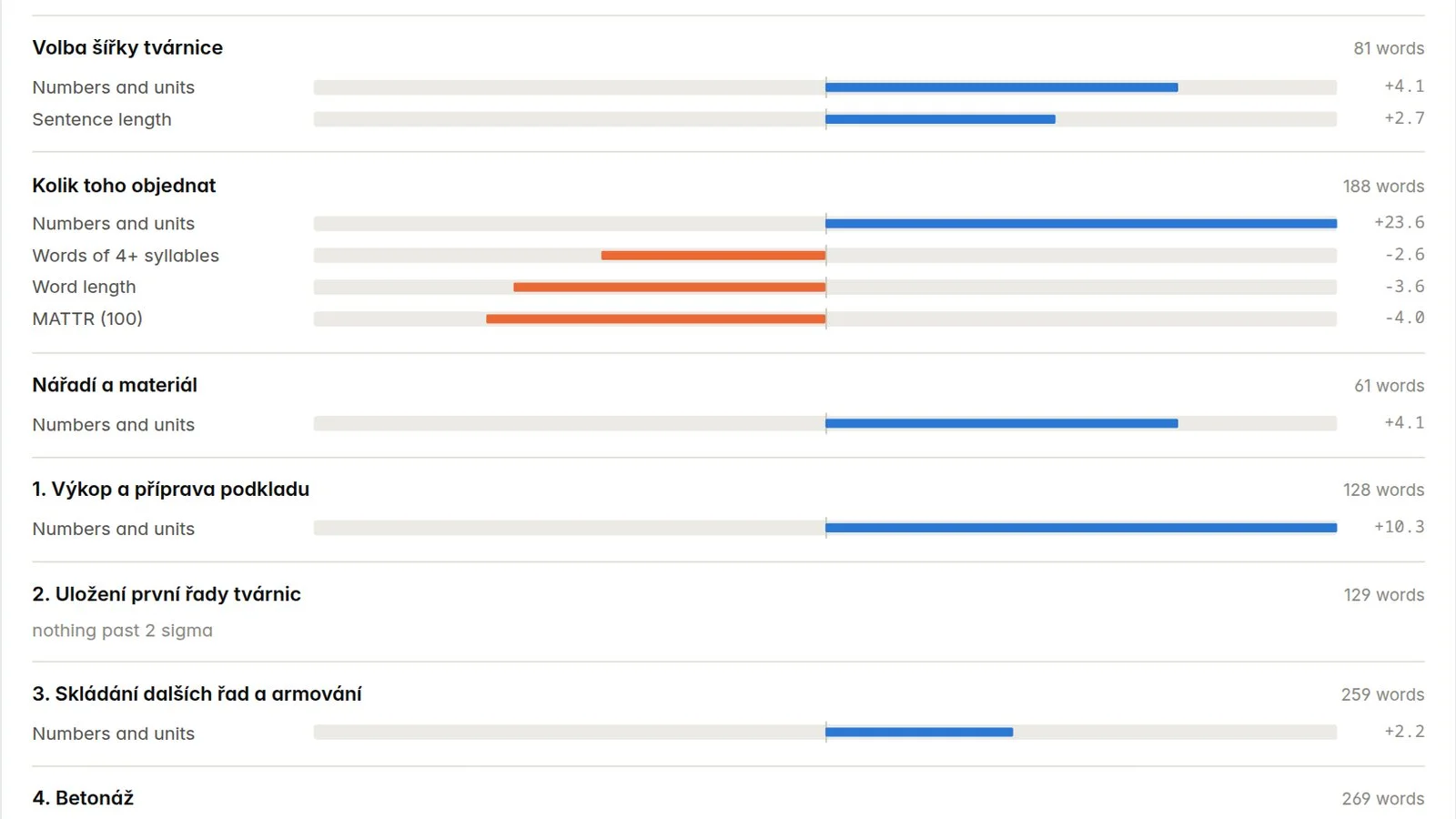
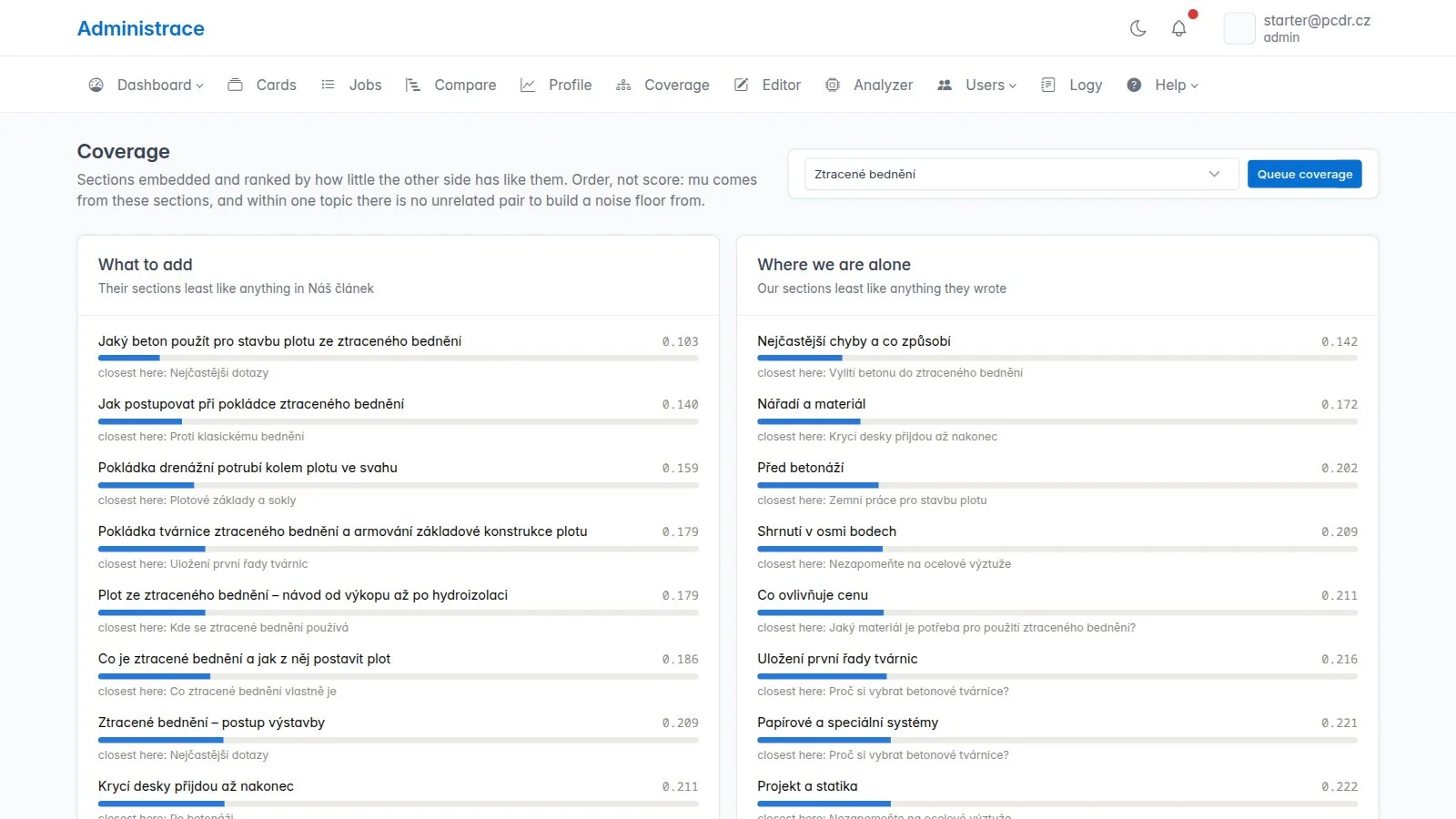
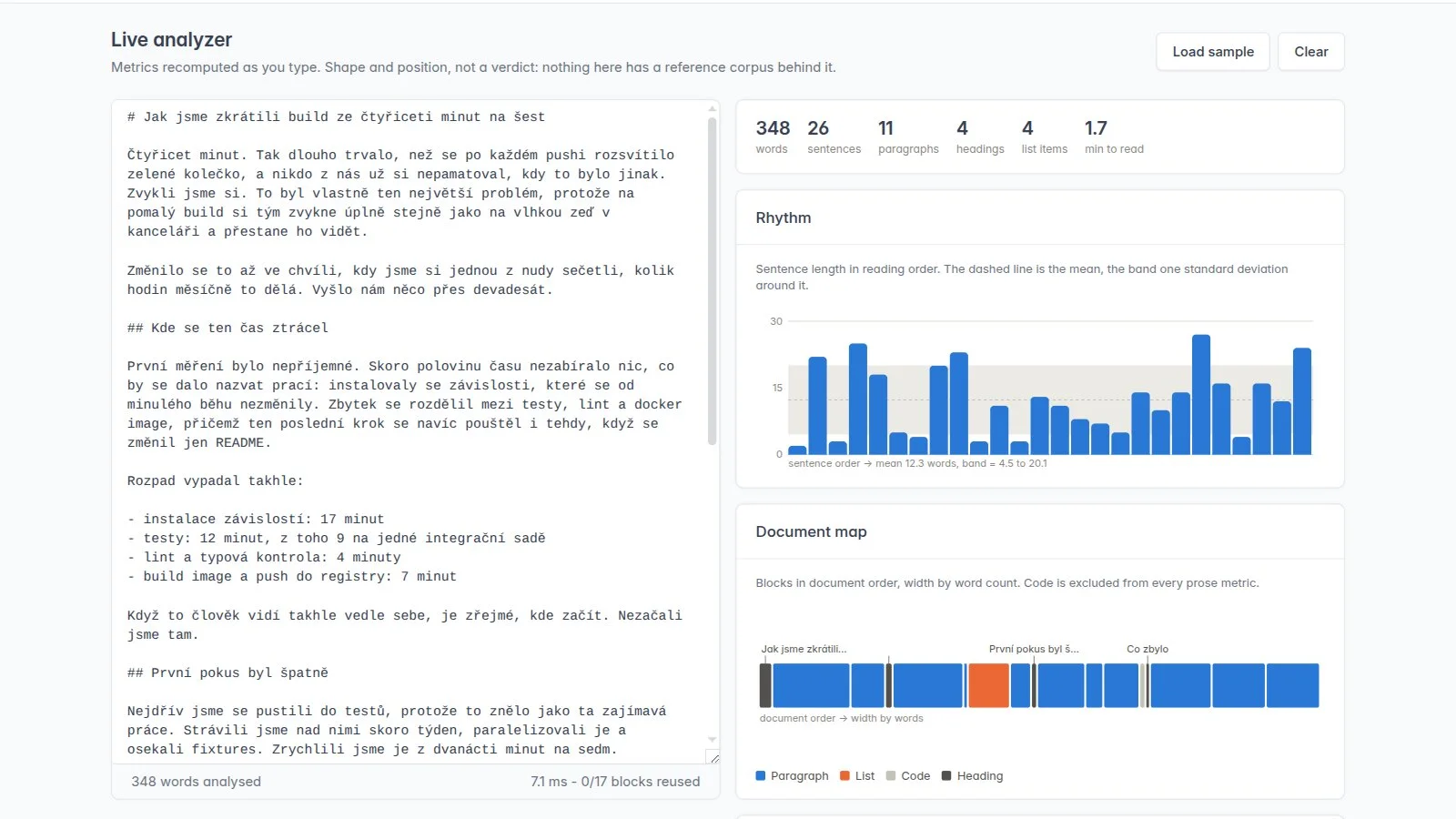
Revertex measures stylometry (sentence rhythm, lexical variety, structure, hedges, numbers and units), Czech morphology and syntax through UDPipe (verbs per noun, passive, dependency distance, subordinate clauses), and semantics through embeddings from a local model in Ollama. From the measured data I generate a lot of visualizations. The numbers alone would tell me nothing, but once I turn them into a 3D vector space and add a few different charts, I can see what is going on at a glance.
Embedding spaces are anisotropic: two unrelated Czech sentences have a cosine similarity around 0.45, not zero. Every vector is therefore centred against a reference corpus of the same kind (sentences against sentences, sections against sections) and similarity is reported as a percentile against unrelated pairs, with the noise floor visible.
The 3D view projects the centred vectors onto three principal components and joins similar sentences with bonds. It also shows what the model really sees: in an early version of the set above, construction joined cooking through the instructional tone (“we pour”, “we thicken”), not through the topic. Once I rewrote the construction sentences impersonally, three clean groups appeared.
The application has seven modules: texts and their measurements, the queue, comparison on a shared axis, the section profile, coverage, the analyzer status and a live editor. The editor computes and visualizes 24 metrics in the browser as you type (only changed blocks are recomputed) and on request scores each section of the draft against the corpus. The Python and JavaScript copies of the metrics are checked by a parity test on the same texts, because two implementations of one definition drift silently and a port bug looks exactly like a finding.
The project is still a work in progress, but a test version is already available for clients’ content websites.